




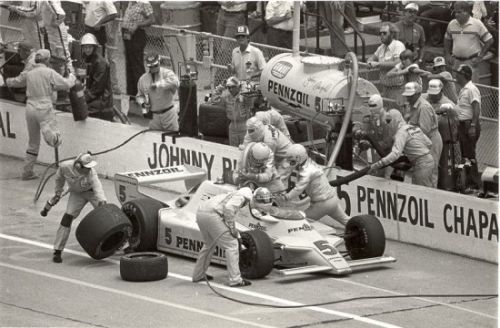
 In the mid-1980s, the series grew significantly. More and more car manufacturers joined the series, more cars were on the track, and talented drivers made their debut or returned to the series. The calendar also changed rapidly; permanent road- and street courses began to play an increasingly significant role on the calendar, which grew to fifteen to sixteen races.
Rick Mears was the man to beat in the early 1980s, scoring three championships in four years. This dominance was broken by Formula 1 champions Mario Andretti and Emerson Fittipaldi, and new faces like Michael Andretti, Bobby Rahal, Al Unser Jr., and Danny Sullivan.
The series continued to grow in the 1990s, becoming a serious competitor to Formula 1. This was due to the continuity that finally existed within the series, especially regarding the calendar. The field was also strengthened by big names like Nigel Mansell, Paul Tracy, and Jacques Villeneuve.
 Despite the series' success, friction arose between the CART organization and Indy 500 President Tony George. George disagreed with the chosen direction of the racing series, while USAC wanted to regain it's power. For this reason, George split with the Indy 500 from CART in 1996 to establish, following the example of NASCAR, an 'All American oval racing league': the Indy Racing League (IRL). This racing series was to be accessible to American USAC (midgets) drivers, with less technology, lower costs, exclusively ovals, and with the Indy 500 as its showpiece.
The creation of this new racing series caused CART to lose its main event of the season, but despite the loss of this race and the international field, the series remained popular among American fans. The CART races featured large grids with a highly competitive field. In the late 1990s, drivers like Alex Zanardi, Jimmy Vasser, Greg Moore, Juan Pablo Montoya, Paul Tracy and Michael Andretti were the stars of the CART field.
The Indy Racing League faced initially more difficulties. Few prominent names had made the switch, significant investments were needed to maintain large grids and the Indy 500 lost some of its luster as the driver level was considerably lower than in CART.
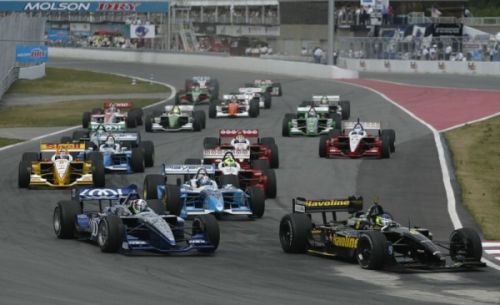 However, the new millennium brought a completely different climate for the series. The declining economy and the loss of Honda, Toyota and several top teams to the IRL pushed CART to the brink of collapse. CART went into debt, the field shrank and fewer fans and media showed interest in the series. To turn the tide, the series hoped to make a fresh start in 2003 with the new name ‘Champ Car World Series,’ but it was to no avail.
In 2003, the series even declared bankruptcy, with the intention that team owners Kevin Kalkhoven, Paul Gentilozzi and Gerald Forsythe would buy back the series under the name ‘Open Wheel Racing Series’ (OWRS). However, IRL owner Tony George also saw an opportunity to buy his competitor and made a bid on the remains of CART. Judge Frank J. Otte ultimately chose to award CART to OWRS, ensuring the series' future.
Under OWRS's leadership, the Champ Car calendar was drastically reduced from eighteen to fourteen races. Other cost-saving measures were also implemented, such as banning the further development of cars and retaining the Lola and Reynard chassis built in 2002.
 Meanwhile, the IRL experienced significant growth. Top teams like Team Penske, Chip Ganassi Racing, Team Rahal and Andretti-Green Racing had made the switch, making the IRL the strongest racing series in terms of drivers. However, the IRL also struggled at times to attract full grids and, like Champ Car, had to heavily subsidize teams to maintain full grids. Due to the battle between Champ Car and the IRL, American open-wheel racing lost many of its loyal fans, sponsors and partners.
In the year before its bankruptcy, Champ Car saw an impressive debut from Sebastien Bourdais, who started his first two races from pole position and achieved his first victory in his fourth race. During his debut season, the Frenchman finished as the best rookie in fourth place in the championship, after which he was unbeatable for the next four years, winning four consecutive championships for the first time since Ted Horn in the 1940s.
The 2007 season would be the last year of the 'Open Wheel War' between Champ Car and the IRL. In February 2008, the racing classes would bury the hatchet and continue as one class: the IndyCar Series.