

Average starting position of IndyCar race winners
Let’s get straight to the point: across the 283 analyzed races, the average starting position of the eventual winner was 5.22. This may sound surprisingly high, but it is partly due to the large number of races won from outside the top ten.Of the analyzed races, a remarkable 42 were won from outside the top ten. The most recent example occurred during the 2024 season finale at Nashville Superspeedway, when Colton Herta won the race after starting from the eleventh position. Earlier in the season, Power won even from 23rd position (Iowa)!
Power’s 23rd starting position isn’t even the lowest position from which a race has been won. That honor goes to Helio Castroneves, who was disqualified after qualifying at Chicagoland Speedway in 2008 and had to start the race from last place – 28th. The Brazilian ultimately won the race in a photo finish, with a margin of 0.0033 seconds over Scott Dixon.
This does not mean that pole position is unimportant; just over 25% of the races (71 in total) have been won from pole position. The most recent occurrence was when pole-sitter Colton Herta dominated the streets of Toronto and took the win.
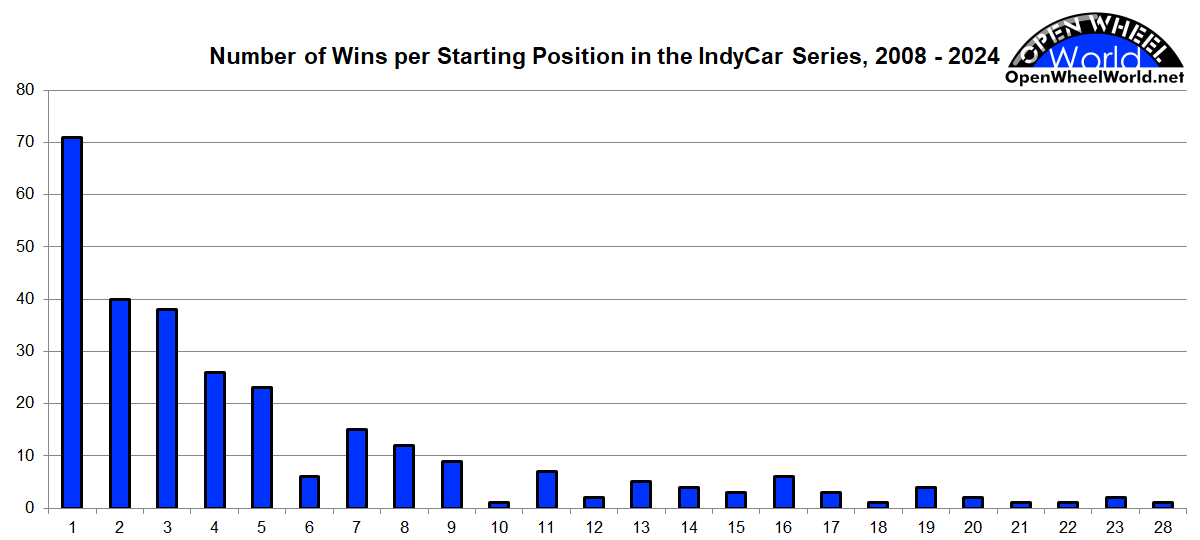 Number of wins per starting position in the IndyCar Series
Average starting positions of race winners per year
Zooming in on the average starting position of race winners per year, we see that the introduction of the Dallara DW12 unquestionably made races more unpredictable. From 2008 to 2011, the average starting position of race winners was 3.34, but during the seasons with the standard DW12 aerodynamic package (2012 – 2014), this number doubled to 6.69!
With the introduction of aerodynamic kits from Honda and Chevrolet (2015 – 2017), little changed. During these years, the average starting position of race winners was 6.55 – slightly lower than with the standard aero package.
The current universal aero kit has, so far, resulted in an average winning starting position of 5.08. This suggests the package offers slightly fewer opportunities than the previous DW12 aero kits, although other factors undoubtedly play a role.
In recent years, particularly on permanent circuits, race control has been slightly more lenient in delaying neutralization during pit stop windows, provided stranded cars are in safe locations. As a result, strategy plays a slightly reduced role, making it harder to win races from poor starting positions.
With the arrival of hybrid technology, strategy is likely to play an even smaller role on permanent and street circuits. Drivers who previously stalled their engines after a spin, for example, needed to be restarted under a caution. Now they can restart their engines themselves, resulting in fewer cautions and thus fewer strategic opportunities.
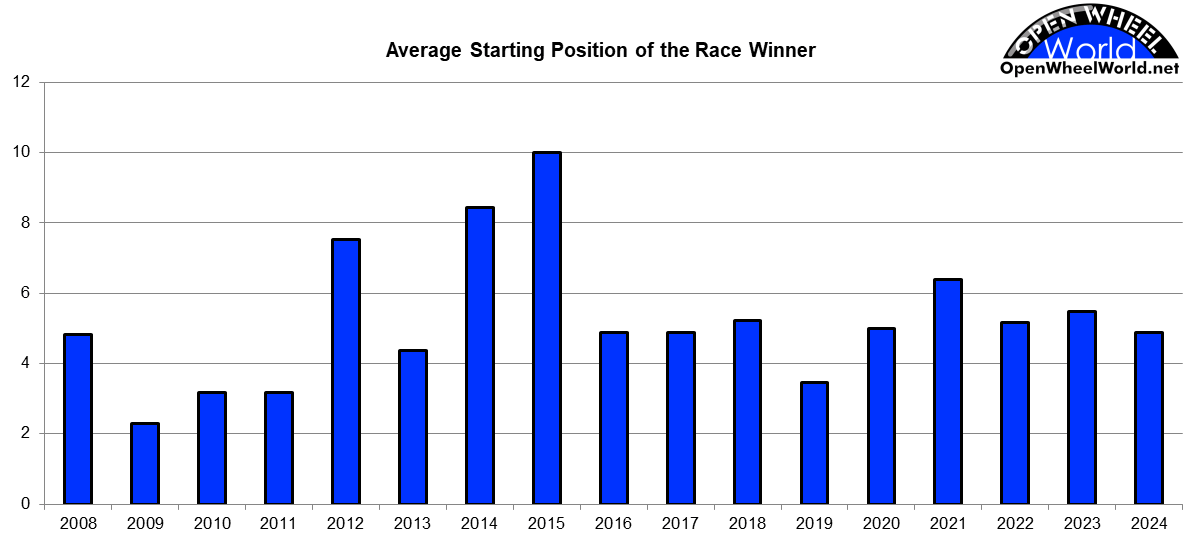 Average starting position of race winners per season
Of all seasons, 2015 was by far the most bizarre. In the first year of Honda and Chevrolet’s aero kits, only one race was won from pole position (the Grand Prix of Indianapolis, by Will Power)! The average starting position of race winners was unusually high: 10th!
That year, seven of the seventeen races were won from outside the top ten, with the lowest winning position being 20th, achieved by Carlos Muñoz in the Detroit Grand Prix.
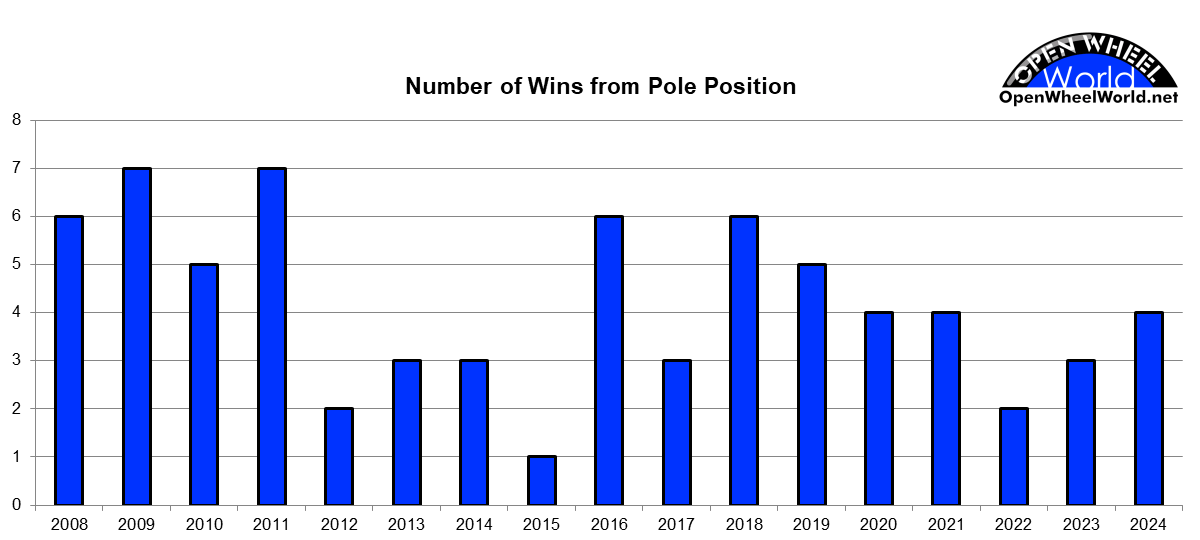 Number of IndyCar wins from pole position, per season
Over the coming weeks, we will dive even deeper into the data.
For this analysis, we used the qualifying positions of eventual race winners. Grid penalties were not taken into account. Additionally, the 2008 races in Motegi and Long Beach were excluded as they were contested with split fields before the unification.
Also in this Serie:
- Average Winning Starting Positions per Driver
- The Average Winning Position Per Track
PhotographyPenske Entertainment