Occasional race meets would be presented at the track, featuring those very same manufacturers racing their products against each other. Spectators, it was reasoned, would be sufficiently impressed as to want to head downtown quickly to the showrooms for a closer look at one of these new-fangled contraptions.
The original design for the track called for four turns, each banked at nine degrees and 12 minutes and measuring exactly 440 yards from entrance to exit, were linked together by a pair of long straights and, at the north and south ends of the property, by a pair of short straights to form a rectangular-shaped 2 ½ mile track as dictated by the confines of the available land. The same layout is used today.

When the first race took place in August, 1909, the celebration quickly turned into a disaster due to the surface of crushed stone and tar. There were terrible injuries to the race car drivers and spectators. Cars caught fire, there were deaths, and the race was halted and canceled when only halfway completed. Louis Schwitzer was declared the winner in front of twelve thousand spectators. At this point owners decided the track needed a new surface. 3.2 million paving bricks were imported by rail from the western part of the state in the fall, laid on their sides in a bed of sand and fixed with mortar, this inspiring the nickname "The Brickyard".
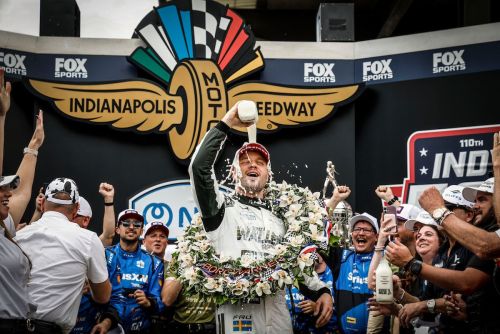
In 1910 Poor attendance at a trio of three-day meets on the revamped brick surface caused the owners to rethink their plans and focus instead on a single event for 1911. They envisioned it as an event of gigantic proportions offering a huge purse. On May 30 - Memorial Day - a grueling 500-Mile race paying $14,250 to win took place, enjoying instant success and attracting universal recognition. Attracting an estimated 80,000 spectators to the first 500 mile race on Memorial Day 1911, at $1 admission, the Speedway reopened and hosted the first in a long line of five hundred races now known as the Indianapolis 500.
The race was interrupted in the years 1917 and 1918 by World War I, when Indy served as a military hub for repairs. Just before this period, however, on September 9, 1916, the Speedway hosted a day of short racing events termed the "Harvest Classic," composed of three races held at 20, 50 and 100-mile (160 km) distances. When racing resumed, speeds increased and by 1925, when Peter DePaolo won, the best cars were averaging 100 mph (160 km/h) for the race.

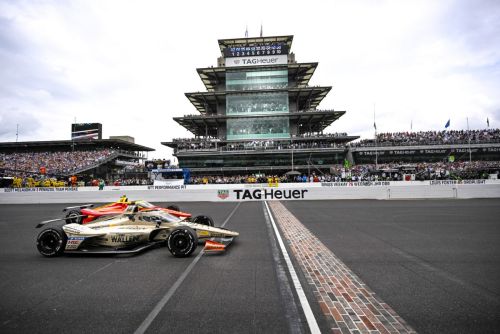
Asphalt was first applied to the rougher portions of the track in 1936, and by 1941 all but the greater part of the mainstraight had become blacktop. The remainder of the bricks was finally covered over in the fall of 1961. Most of the original paving bricks are still in place underneath the modern asphalt surface, with only the famous "yard of bricks" still exposed at the start/finish line as a nostalgic reminder of the past.
The track has changed ownership only twice. With Carl Fisher heavily involved in the development of Miami Beach and Jim Allison's nearby engineering company growing rapidly, the foursome sold IMS in 1927 to a group headed up by WWI flying ace Eddie Rickenbacker. Rickenbacker had actually driven in several 500s before he ever knew how to fly. One of Rickenbacker's first actions was to install an 18-hole golf course on the grounds in 1929, now known as Brickyard Crossing and home of a Senior PGA Tour golf tournament, the Brickyard Crossing Championship, in September.
With US involvement in World War II, the 1942 500-Mile race was cancelled in December of 1941. Late in 1942, a ban on all auto racing led to the canceling of the 500-Mile Race for the rest of the war for a total of four years (1942-1945). The track was more or less abandoned during the war and was in bad shape.

Many of the locals conceded that the Speedway would be sold after the war and become a housing development. With the end of the war in sight, on November 29, 1944, 3-time 500 winner Wilbur Shaw came back to do a 500-mile tire test approved by the government for Firestone. Shaw was shocked at the state of the Speedway and contacted owner Eddie Rickenbacker only to discover that it was for sale. Shaw then sent out letters to the automobile industry to try to find a buyer. All the responses indicated that the Speedway would be turned into a private facility for the buyer. Shaw then looked around for someone to buy the Speedway who understood what it was about. He found Terre Haute, Indiana businessman Tony Hulman, who had made his fortune manufacturing goods such a Clabber Girl Baking Powder. Meetings were set up and the purchase of the Speedway happened on November 14, 1945. Though not officially commented on, the purchase price for the Speedway was reported by the Indianapolis Star and News to be $750,000. Major renovations and repairs were made at a quick pace to the frail Speedway before the 1946 race. Since then and up to today, the Speedway continues to grow. Stands have been built and remodelled many times over, suites and the museum were added, and many other additions helped bring back Indy's reputation as a great track.
Fast Facts
With the exception of an additional program of racing on a single day in September 1916, no race other than the Indianapolis 500 was to be held at the Speedway until the Brickyard 400, debuted in 1994. The 500 was suspended during America's involvement in the two world wars, 1917-1918 and 1942-1945, but held in all other years.
Placed on the National Register of Historic Places in 1975 and designated a National Historic Landmark in 1987, Indianapolis Motor Speedway currently remains the only such landmark to be affiliated with automotive racing history since its inception.
The Speedway also hosted the United States Grand Prix for Formula One from 2000-07, the inaugural race drew an estimated 225,000 which set a Formula One attendance record.

The following land marks could all be fit in the infield of the Indianapolis Motor Speedway: Vatican City ,the Colosseum in Rome, all England Lawn Tennis and Croquet Club Campus (home of the Wimbledon Championships), the Rose Bowl Stadium, Yankee Stadium and the racetrack at Churchill Downs (home of the Kentucky Derby).
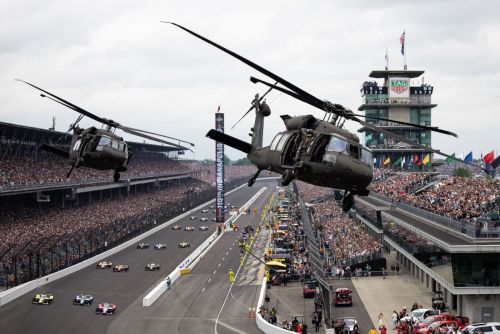
The “Pagoda” which has become an Indianapolis Motor Speedway Icon was originally built in 1913. In 1925 the structure was intentionally burnt to the ground after the Indianapolis 500 and was replaced with a similar yet slightly larger version in time for the 1926 race. As speeds increased, officials felt the original Pagoda was built too close to the track, and thus the new Pagoda was built considerably further back from the main straightaway. Construction on the new Bombardier Pagoda which still stands today, begun in 1998 and was completed in 2000, the current building has 10 floors and rises to the height of a 13-stories. This nostalgic structure replaced the glass-and-steel Master Control Tower, which was built during the winter of 1956-57.
Written 05-16-2008, 12:46 am
Updated 05-16-2008, 07:52 am
Photography IMS
Copyright © 2004-2010 OpenWheelWorld.net