

Still, it was clear that Chevrolet held the competitive advantage, enough to invoke rule 9.3 and allow Honda to further modify and their develop their aero specs.
The results were on full display in Phoenix for an open test involving all teams and drivers. Indeed, Honda was not the only one to update their bodywork as Chevrolet introduced some new designs as well. Chiefly, the winglets on the rear-wheel pods have a square shape to them as opposed to a rounded shape last year.
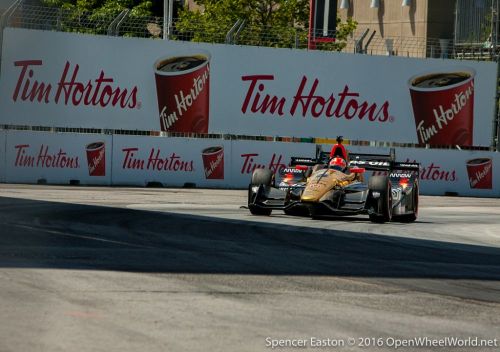
The Honda, though, is a complete revamp. In fact, it looks strikingly similar to Chevrolet’s, resulting in several jokes labeling it a “Hondalet” or “Chevronda.” It is not surprising, though, given the dominance of Chevrolet last year, that the Honda kit looks more like a Chevrolet kit.
Honda has abandoned last years striking stacked and curved triple-element front wing for a dual-element package that mirrors Chevrolet’s. The most glaring difference comes in the endplates. Honda’s revamp features a split-piece model that is slightly shorter than Chevrolet’s, which sports a one-piece design that runs the length of the wing’s edge.
For the sidepods, Honda is going with split sidepods that form a gap between the sidepods, rear tires, and transmission, again similar to Chevrolet’s design. However, that is only for the road courses and short ovals; Honda teams will use their 2015 designs on the super speedways. Honda’s rear tire ramps have also been altered, forming a solid, curved shape instead of last year’s “winglet” approach.

Still, the Honda camp does not appear in dire straights. Graham Rahal and Marco Andretti also showed impressive speed during the two days in Phoenix, with Andretti even leading Session 2 (though, it should be noted that many teams ran on used tires from earlier in the day and Andretti was one of the only drivers to do a qualifying sim during that particular session). Ryan Hunter-Reay, Takuma Sato, Carlos Munoz, Luca Filippi, and Conor Daly also impressed.
Heading next weekend’s season opener in St. Pete, Chevrolet still appears to hold an outright speed advantage, but the performance gap is much closer. Further, the Honda teams were not using their 2016 spec engines during the Phoenix test. They will be introduced at the opening race, meaning Honda may still have speed in hand.
It is difficult, even borderline impossible, to predict the overall landscape based on testing. However, Honda is much closer to Chevrolet out of the box then they were one year ago, which indicates that the field may be more evenly matched when they get to St. Pete.
OpenWheelWorld.net